

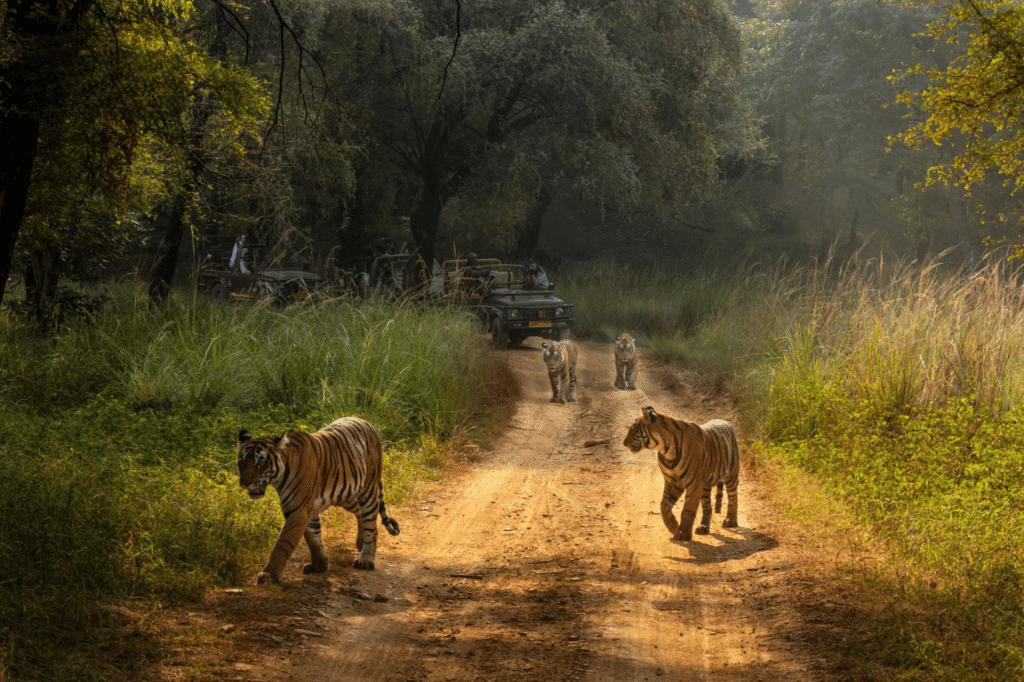
What Tigers Eat in Ranthambore: Understanding the Prey Base
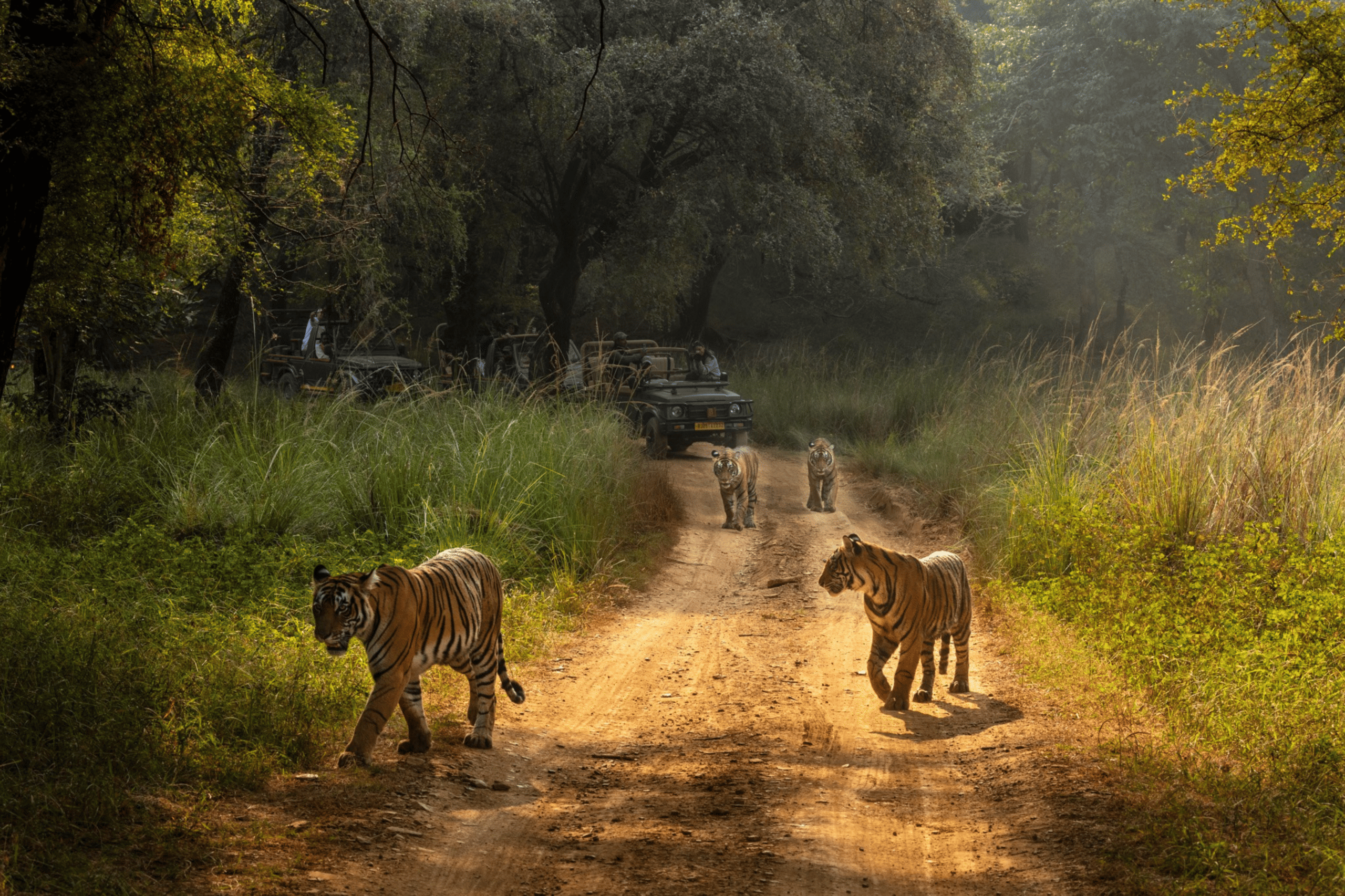
hen people think about Ranthambore, they usually think about one animal first: the Bengal tiger. But a tiger cannot survive in a forest by itself.
Behind every healthy tiger population is a much larger network of animals, plants, water sources, and habitats that make survival possible.
In Ranthambore, species such as sambar deer, chital, langurs, nilgai, and wild boar form an important part of this ecological network. Understanding what tigers eat reveals something fascinating about the reserve: a tiger sighting is actually the visible end of a much larger food chain.
What Do Tigers Eat in Ranthambore?
The main prey species of tigers in Ranthambore include sambar, chital, common langur, nilgai, wild pig, and chinkara.
Among these, sambar and chital are particularly important prey species. Research and conservation studies indicate that these two species make up a significant portion of the documented tiger diet in the reserve.
This highlights an important principle of tiger conservation: protecting tigers also means protecting the animals they depend upon.
Sambar Deer: One of Ranthambore's Most Important Prey Species
The sambar is one of the most important prey animals for Ranthambore’s tigers.
It is India’s largest deer species and is commonly associated with forests, grasslands, and areas close to water.
For a large predator such as the tiger, a sizeable ungulate can provide a substantial amount of food compared with smaller prey.
Ranthambore’s tiger conservation studies identify sambar as a principal prey species of the tiger in the reserve.
This makes the sambar more than just another animal that visitors photograph during a safari. It is an important part of the ecological foundation supporting the reserve’s tiger population.
Chital: The Spotted Deer of Ranthambore
If you have been on a Ranthambore safari, you have probably seen groups of spotted deer.
Known as chital, these deer are among the most commonly observed herbivores in the reserve.
Their presence is important because they feed on vegetation and form part of the prey base for carnivores.
Their behaviour can also provide clues about predator activity.
A sudden change in the behaviour of a herd can sometimes attract the attention of an experienced guide.
So when you see a large herd of chital during a safari, you are not simply looking at beautiful deer. You are looking at one of the species that helps sustain the larger predator-prey system.
Langurs: Small Animals With a Big Role
Common langurs are another recognised prey species of Ranthambore’s tigers.
However, their importance goes beyond being potential prey.
Langurs are highly alert animals, and their alarm behaviour can sometimes help visitors and guides notice the presence of a predator.
Imagine driving quietly through the forest when a langur suddenly becomes extremely alert and begins looking towards the same area repeatedly.
For an experienced guide, these behavioural changes can become useful clues.
This is why learning about prey species can make a tiger safari more interesting. You begin paying attention to the animals that are watching the forest around them.
Wild Boar: An Important Part of the Food Web
Wild boar are another prey species found within Ranthambore’s tiger ecosystem.
They are adaptable animals that can occupy a variety of habitats and spend considerable time foraging.
Although they may not receive the same attention as deer, wild boar are part of the wider prey community that supports large carnivores.
This is an important lesson in wildlife ecology: a tiger reserve is not built around one species. It is an interconnected system.
Nilgai and Chinkara
Nilgai and chinkara also occur in the Ranthambore landscape and are included among the tiger’s recorded prey species.
However, these species contribute less to the documented tiger diet than major prey species such as sambar and chital.
This difference helps explain how predators use their environment.
Just because an animal is available does not mean it becomes an equally important part of a predator’s diet.
Factors such as prey size, availability, habitat, behaviour, and hunting opportunities can influence what predators actually consume.
Why Prey Size Matters to Tigers
A tiger is a large carnivore, which means the energy gained from a successful hunt needs to justify the energy and risk involved in making the kill.
Studies of Ranthambore’s tiger ecology indicate that tigers commonly rely on relatively large prey animals.
This helps explain why large ungulates such as sambar and chital are so important.
A successful hunt of a large prey animal can provide a significant amount of energy to a tiger.
But hunting is never guaranteed.
A predator can spend considerable time searching, stalking, and attempting to capture prey without making a successful kill.
The Tiger Is Only One Part of the Food Chain
It is easy to look at Ranthambore and think:
Forest → Tiger
The reality is much more complicated.
A simplified version looks more like:
Plants → Herbivores → Tigers and other predators
But even this is an oversimplification.
Different herbivores consume different vegetation. Different predators compete for different prey. Birds, reptiles, insects, fungi, and microorganisms also contribute to the ecosystem.
Water influences vegetation.
Vegetation influences herbivores.
Herbivores influence predator populations.
The entire system is connected.
Why Water Matters to the Prey Base
Ranthambore’s landscape includes lakes, rivulets, waterholes, grasslands, and dry deciduous forests.
These water sources can become important gathering points for wildlife, particularly during hot and dry periods.
When water becomes concentrated in particular locations, herbivores and other wildlife may use those areas more frequently.
This can make water sources important parts of the wider ecosystem.
However, a waterhole does not guarantee a tiger sighting. Wild animals are free to move according to their needs and natural behaviour.
Why Prey Abundance Matters for Tiger Conservation
A tiger reserve needs more than protected forest. It needs suitable habitat and enough prey to support predator populations.
Tiger conservation therefore involves protecting not only tigers but also the prey species and habitats that sustain them.
This creates an important conservation principle:
You cannot protect the tiger by focusing only on the tiger. You also have to protect the ecosystem that feeds it.
What Happens If the Prey Base Declines?
Imagine a forest with plenty of tigers but fewer deer and other prey animals.
The problem would eventually reach the predators.
With less natural prey available, competition between predators can increase and the ability of the habitat to support a healthy tiger population can decline.
This is why monitoring prey populations is an important part of tiger conservation.
Conservation is not simply about counting tigers. It involves understanding the entire habitat.
Why You Should Watch Deer During Your Safari
The next time you enter Ranthambore, try something different.
Instead of asking your guide, “Where are the tigers?”, ask:
“How are the deer behaving?”
Watch a herd of chital.
Look at sambar near a water source.
Notice when animals suddenly become alert.
Listen for alarm calls.
Look at where animals are feeding.
These observations can give you a completely different understanding of the forest.
The tiger may be hidden, but the ecosystem around it is constantly communicating.
The Hidden Story Behind a Tiger Sighting
Suppose you finally see a tiger walking through the forest.
Most visitors immediately focus on the tiger.
But look around.
There may be deer nearby. There may be langurs watching from the trees. There may be birds reacting to movement. There may be a water source nearby. There may be a trail used repeatedly by animals.
That one tiger is part of a much larger ecological story.
The sighting is exciting because of the animal in front of you. The science becomes fascinating when you understand everything behind it.
Ranthambore Is More Than a Tiger Reserve
The word “tiger” often dominates conversations about Ranthambore.
But the reserve is home to a much wider range of wildlife.
Ranthambore’s ecosystem supports species including sloth bears, leopards, caracals, jackals, foxes, hyenas, mongooses, chital, sambar, nilgai, langurs, and numerous bird species.
This biodiversity is what makes the reserve an ecosystem rather than simply a destination for tiger sightings.
The tiger is one of its most famous inhabitants.
It is not its only inhabitant.
The Bigger Conservation Picture
Ranthambore also plays a role in a wider tiger landscape.
The reserve is connected to surrounding protected and forested areas, making ecological connectivity an important part of long-term tiger conservation.
These connections matter because wildlife conservation does not stop at the boundary of a single protected area.
Tigers and other animals need functioning landscapes through which populations can move and disperse.
This is why habitat corridors and ecological connectivity are important parts of modern tiger conservation.
The Real Meaning of a Healthy Tiger Population
A healthy tiger population is not simply a number on a report.
It can indicate that a much larger ecological system is functioning.
There must be:
- Suitable habitat
- Adequate prey
- Water
- Protection
- Connectivity
- Space for wildlife
- Effective conservation management
When these elements work together, the forest has a stronger foundation for supporting predators.
The Real Meaning of a Healthy Tiger Population
A healthy tiger population is not simply a number on a report.
It can indicate that a much larger ecological system is functioning.
There must be:
- Suitable habitat
- Adequate prey
- Water
- Protection
- Connectivity
- Space for wildlife
- Effective conservation management
When these elements work together, the forest has a stronger foundation for supporting predators.
Final Thoughts
The next time someone asks you what tigers eat in Ranthambore, you can give them a much more interesting answer than simply saying “deer.”
Ranthambore’s tiger prey base includes sambar, chital, langur, wild pig, nilgai, and chinkara, with sambar and chital playing particularly important roles.
But the real story is bigger.
Every tiger depends on an ecosystem.
Every ecosystem depends on countless species.
And every safari gives you a chance to see those connections happening in real time.
So the next time you are in Ranthambore, don’t only look for the tiger.
Look at what the tiger’s forest is telling you.


