

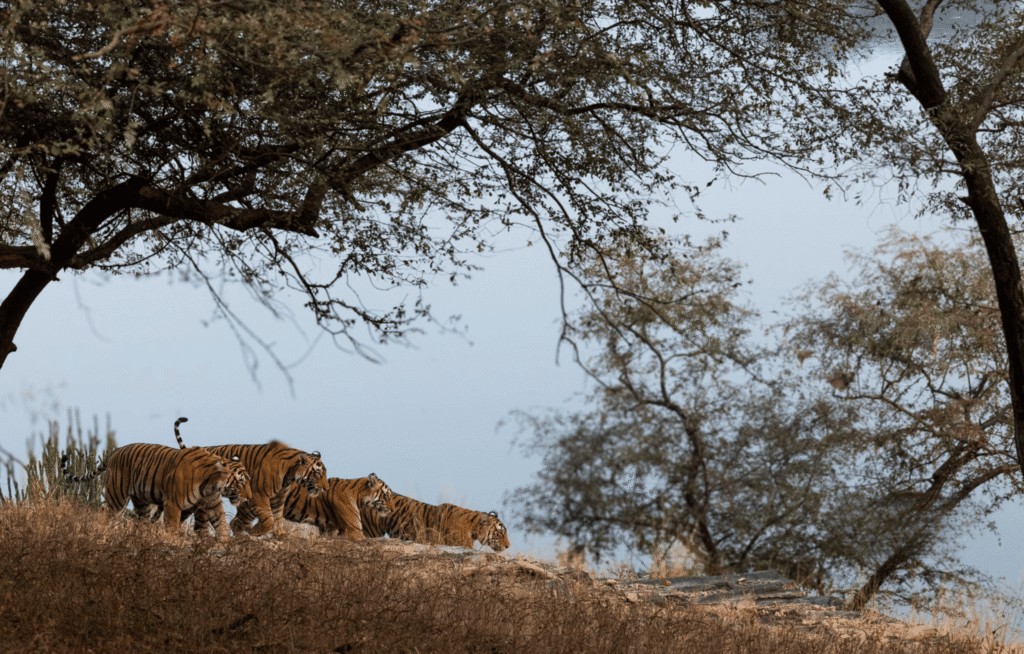
Why Ranthambore Looks So Different From Other Tiger Reserves
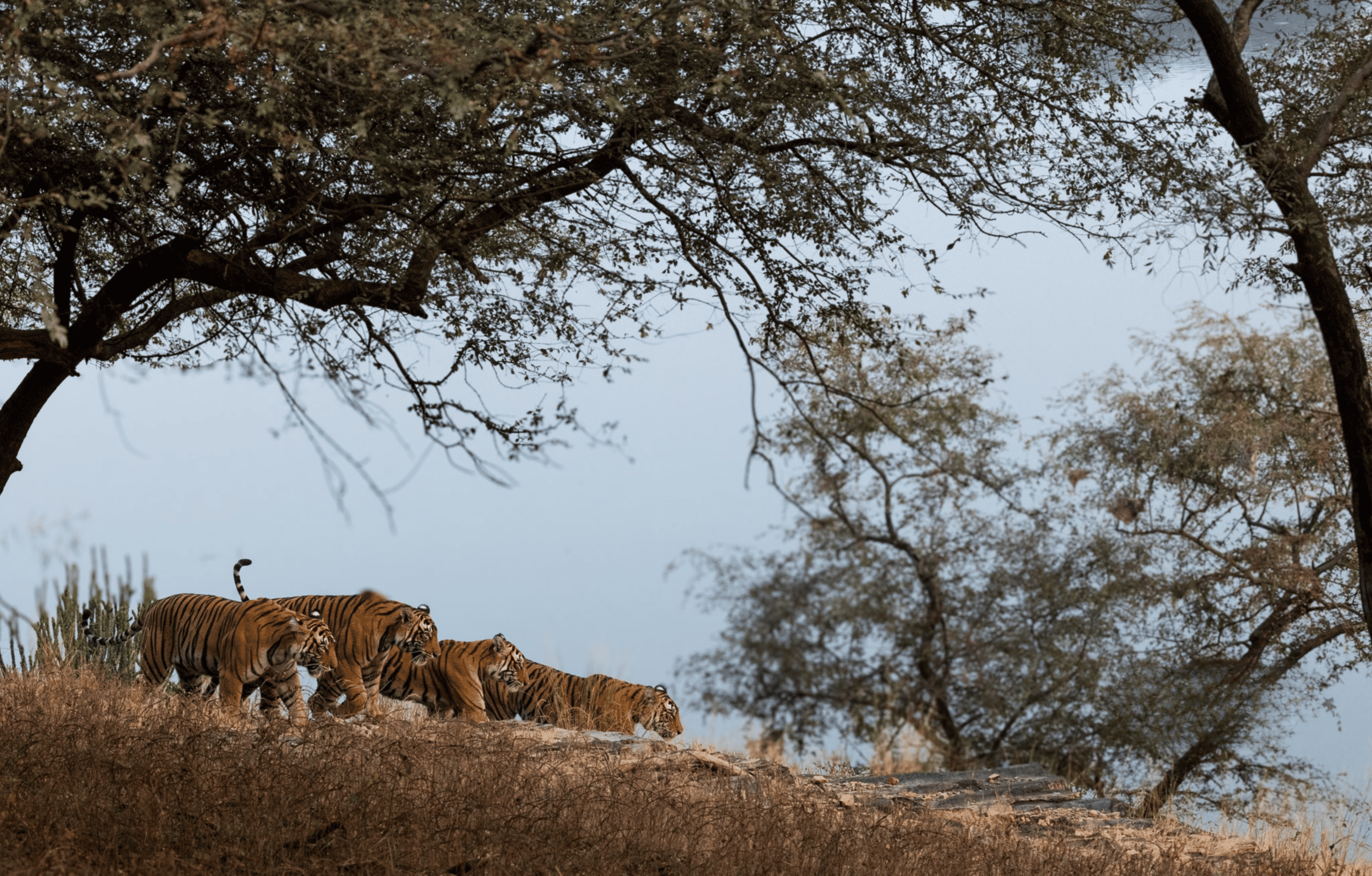
When people imagine a tiger reserve, they often picture a dense green forest filled with tall trees.
Ranthambore looks very different.
Here, ancient fort walls rise above dry forests, rocky hills surround open grasslands, and lakes sit between dramatic ruins and woodland. The landscape can look almost harsh at first, yet it supports tigers, leopards, sloth bears, deer, crocodiles, langurs and hundreds of bird species.
This unusual combination of dry forest, rocky terrain, water bodies and historical architecture is one of the things that makes Ranthambore unique.
A Forest Shaped by Two Mountain Systems
Ranthambore lies at the meeting point of the Aravalli and Vindhya mountain ranges, giving the landscape a distinctive combination of hills, valleys and rocky formations.
Rajasthan Tourism describes the reserve as a dry-deciduous forest system containing rolling hills, crags, meadows, lakes and rivulets.
This geography affects almost everything you see during a safari.
The terrain creates valleys and natural routes through which wildlife moves. Rocky hills provide shelter and elevated areas, while open meadows provide feeding grounds for herbivores.
Instead of one continuous type of forest, Ranthambore is a patchwork of different habitats.
The Dhok Forest: Ranthambore's Dominant Landscape
One of the most characteristic trees of Ranthambore is dhok (Anogeissus pendula).
Dhok is well adapted to the relatively dry conditions of the region and forms an important part of the reserve’s vegetation.
During the dry season, the landscape can appear brown and sparse compared with the lush forests people often associate with wildlife reserves.
But this does not mean the forest is empty.
The dry environment supports a surprisingly diverse range of wildlife.
Chital and sambar feed across the landscape, langurs move through the trees, and predators use the surrounding forests, valleys and rocky terrain.
Why Ranthambore Has So Many Water Bodies
Water is one of the most visually striking features of Ranthambore.
The reserve contains lakes and wetlands including Padam Talab, Rajbagh and Malik Talab. Rajasthan’s identified-wetlands list specifically includes these water bodies within the Ranthambore Tiger Reserve.
These water sources are important because water influences where animals can live and move.
During the hotter and drier months, permanent or more reliable water sources can become particularly valuable to wildlife.
They also create areas where different habitats meet.
A lake can provide water for animals while its surrounding vegetation provides food and shelter.
For safari visitors, these areas can therefore offer opportunities to observe several species within the same landscape.
The Famous Padam Talab
Padam Talab is one of Ranthambore’s best-known landscapes.
The large water body is surrounded by forest and open areas, creating a striking setting for wildlife photography.
The famous Jogi Mahal stands beside the lake, adding a historic element to the natural landscape.
This combination is one of the reasons Ranthambore photographs can look so different from photographs taken in other tiger reserves.
You may have a tiger in the foreground, a lake behind it, dry forest on the hills, and historic architecture completing the scene.
It is a rare combination of wilderness and heritage.
Raj Bagh: Where Ruins Meet the Jungle
Another distinctive feature of Ranthambore is the presence of historic ruins within the wildlife landscape.
The ruins around Raj Bagh are surrounded by vegetation and wildlife, creating an unusual meeting point between history and nature.
Old arches, walls and stone structures have gradually become part of the forest environment.
For visitors, this creates something more than a wildlife-viewing experience.
You are not simply travelling through a forest.
You are travelling through a landscape where centuries of human history and natural processes exist alongside each other.
Ranthambore Fort and the Wildlife Landscape
The Ranthambore Fort dominates the landscape from its elevated position.
The fort dates back centuries and is one of the defining landmarks of the region.
Its presence inside the wider national park is unusual when compared with many other tiger reserves.
From certain areas of the reserve, the fort can appear above the trees and hills while wildlife moves through the landscape below.
This is one of the strongest visual characteristics of Ranthambore:
A historic fortress overlooking a living tiger habitat.
Why the Rocky Terrain Matters
The rocks and hills of Ranthambore are not simply scenic backgrounds.
They are part of the habitat.
Rocky terrain creates natural shelters, elevated areas and narrow valleys. Different species use these landscapes in different ways.
Predators can move through valleys and forested areas while herbivores use open spaces for feeding.
The terrain also creates changes in vegetation and water availability across relatively short distances.
This means that two parts of the reserve can look completely different even though they are relatively close to each other.
Open Meadows Are Just as Important as Forest
A tiger reserve does not need to be covered entirely by dense trees.
Open grasslands and meadows are extremely important parts of Ranthambore’s ecosystem.
Herbivores such as chital and sambar use these areas for feeding.
Their presence, in turn, supports predators.
Open areas can also provide better visibility for wildlife watchers and photographers.
A tiger crossing an open meadow can sometimes be easier to observe than one moving through thick vegetation.
This mixture of open and wooded habitat is one of the reasons Ranthambore offers such varied safari experiences.
A Dry Forest Can Still Be Full of Life
One of the biggest misconceptions about Ranthambore is that the dry appearance of the forest means there is less wildlife.
The opposite can often be true.
The reserve supports a wide variety of mammals, reptiles and birds.
Rajasthan Tourism lists species including tiger, leopard, sloth bear, caracal, jackal, fox, hyena, mongoose, chital, sambar, nilgai, langur and numerous bird species.
The landscape may appear quiet at first, but once you begin paying attention, you start noticing movement everywhere.
A langur calling from a tree.
A chital herd moving across an open area.
A crocodile resting near the water.
Birds circling above the forest.
And somewhere beyond them, a tiger moving silently through its territory.
The Wildlife Is Connected to the Landscape
The different habitats of Ranthambore are connected.
Water supports vegetation.
Vegetation supports herbivores.
Herbivores support predators.
Rocky hills and forests provide shelter and movement routes.
This means that the landscape itself is part of the tiger story.
When you see a tiger near a water body or crossing an open meadow, that sighting is influenced by the habitat surrounding it.
Understanding this connection makes a safari much more interesting.
Why Every Safari Can Look Different
Because Ranthambore contains such varied terrain, no two safari experiences have to look the same.
One drive might take you through dry woodland.
Another might pass rocky hills.
Another could bring you alongside a lake surrounded by open grassland.
The weather and season can change the appearance of the same landscape as well.
After rainfall, vegetation can become greener.
During the dry season, the forest can become more open and golden.
As temperatures rise, wildlife behaviour can also change.
The landscape is constantly changing, even when the basic geography remains the same.
Ranthambore's Most Unique Feature: Nature and History Together
Perhaps the most unusual thing about Ranthambore is not one animal or one landmark.
It is the combination.
Few safari landscapes offer the same experience of seeing:
Tigers + lakes + dry forests + rocky hills + ancient ruins + a historic fort
within one destination.
Ranthambore’s landscape tells two stories at the same time.
One is the story of wildlife surviving in a dry forest ecosystem.
The other is the story of centuries of human history surrounding that wilderness.
Together, they create an experience that is distinctly Ranthambore.
Look Beyond the Tiger
A tiger may be the reason many travellers come to Ranthambore.
But the landscape is what makes the experience memorable.
Look at the hills.
Notice the dry forest.
Watch the water bodies.
Look for birds around the lakes.
Observe deer feeding in open areas.
Notice the old stone ruins being slowly reclaimed by nature.
The more you understand the landscape, the more you begin to realise that a Ranthambore safari is not simply a search for one animal.
It is an opportunity to experience an entire ecosystem.
Final Thoughts
Ranthambore stands apart because of the way its natural and historical landscapes come together.
Its position between the Aravallis and Vindhyas, dry-deciduous forests, rocky terrain, open meadows and important water bodies create a habitat capable of supporting an extraordinary variety of wildlife.
Add the ancient ruins and Ranthambore Fort to that setting, and the result is a landscape unlike a typical tiger reserve.
So when you enter Ranthambore, don’t look only for the stripes.
Look at the forest, the hills, the water and the ruins around them.
They are all part of the story.


